Malware, short for malicious software, refers to any software specifically designed to harm, exploit, or compromise computer systems, networks, or user devices. The term encompasses a wide range of malicious programs or code that are created with the intent to disrupt, damage, steal information, or gain unauthorized access to computer systems. Malware can take various forms and can be distributed through different means, including email attachments, malicious websites, infected software downloads, or even through physical media like USB drives.
Here are common types of malware:
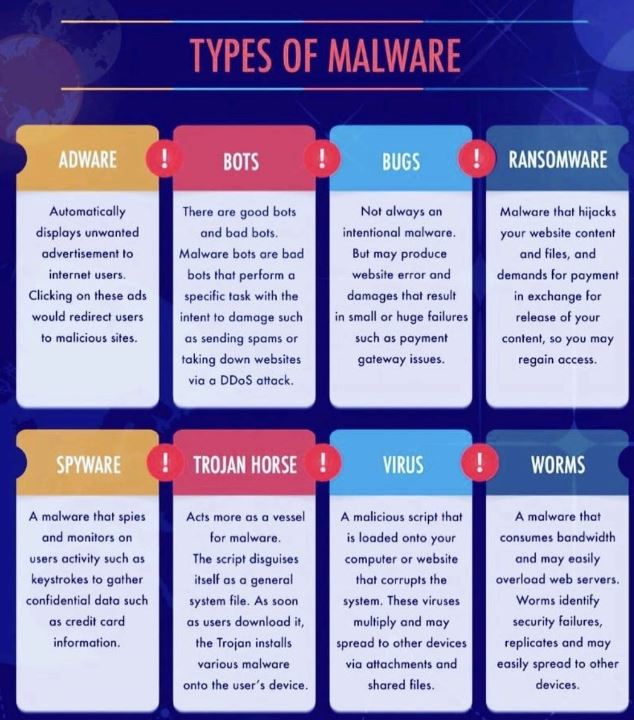
- Viruses: Programs that replicate and spread by attaching themselves to other programs or files. They can damage or delete files, or even render an entire system inoperable.
- Worms: Similar to viruses, worms are standalone programs that can replicate and spread independently, typically over networks. They can consume network resources and slow down systems.
- Trojans (Trojan Horses): Malicious programs disguised as legitimate software. Once installed, they can perform a variety of malicious activities, such as stealing sensitive information, providing unauthorized access, or creating backdoors for other malware.
- Spyware: Software designed to spy on users, collecting information without their knowledge. This may include keystrokes, browsing habits, or personal information.
- Adware: Software that displays unwanted advertisements, often in the form of pop-up windows. While not always malicious, it can be intrusive and affect the performance of the system.
- Ransomware: Malware that encrypts a user’s files, rendering them inaccessible. The attacker then demands payment (usually in cryptocurrency) for the decryption key.
- Botnets: Networks of compromised computers (often called bots) controlled by a central server. Botnets are commonly used for activities like distributed denial-of-service (DDoS) attacks or sending spam.
- Rootkits: Software designed to conceal the existence of certain processes or programs from normal methods of detection. They often provide unauthorized access and control over a computer system.
- Keyloggers: Malware that records keystrokes on a compromised system, allowing attackers to capture sensitive information like passwords.
Malware authors continually evolve their tactics, making it essential for individuals and organizations to use updated antivirus and anti-malware tools, practice safe browsing habits, and keep software and systems up-to-date to defend against the ever-changing threat landscape.