IPv4 is the fourth version of the Internet Protocol (IP). It is one of the core protocols of standards-based internetworking methods on the Internet and was the first version deployed for production in ARPANET in 1983. It still routes most Internet traffic today, despite the ongoing deployment of a successor protocol, IPv6.
How does IPv4 work?
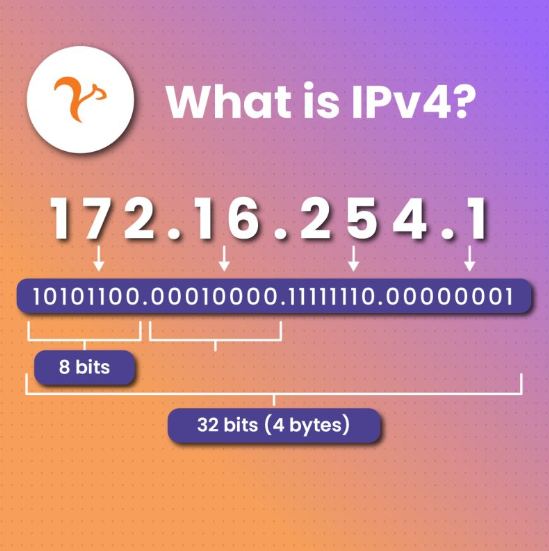
It uses a 32-bit address scheme allowing for a total of over 2 ^ 32 addresses. These IP addresses ensure that the data packets reach the correct destination. Each device connected to the Internet, whether it’s a computer, smartphone, or printer, has at least one IP address.
1. Address Format and Components:
An IPv4 address consists of four 8-bit segments called octects, each separated by dots (e.g., 172✦16✦254✦1) and represent a value from 0 to 255 ie 2 ^ 8.
✳️Network Part: The first three segments (172✦16✦254) identify the network.
✳️Host Part: The last segment (1) uniquely identifies a device within that network.
✳️Subnet Number: If applicable, it further divides the network.
2. Address Types:
✳️Unicast: One-to-one communication like Sending an email to a recipient.
✳️Broadcast: One-to-all communication within a network like Broadcasting a message to all devices on a network.
✳️Multicast: One-to-many communication like Streaming video to multiple viewers simultaneously.
✳️RIP (Routing Information Protocol) is was used as the Routing. Now Replaced by OSPF (Open Shortest Path First) and EIGRP (Enhanced Interior Gateway Routing Protocol).
3 IPv4 Classes : They are divided into five classes. The first three classes A, B amd c are used for unicast, class D is used for multicast, and class E is reserved for future use and research.
4. Header Fields:
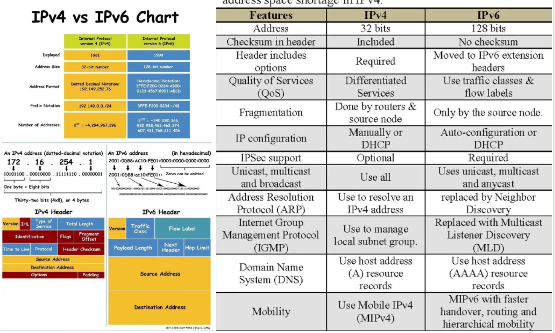
IPv4 headers contain 20 fields, Some key fields include:
✳️Version: Indicates IPv4 (usually 4).
✳️Total Length: Total size of the packet.
✳️Time to Live (TTL): Limits the packet’s lifespan.
✳️Protocol: Specifies the higher-layer protocol (e.g., TCP, UDP).
✳️Checksum: Ensures data integrity.
5. Subnetting in IPv4 : Subnetting is the practice of dividing a network into two or more smaller networks. It’s used to reduce network traffic, improve network performance, and simplify management. IPv4 supports VLSM (Variable Length Subnet Masks), allowing networks to use different subnet mask lengths.
6. Address Resolution Protocol (ARP): ARP maps IPv4 addresses to MAC addresses. Example: When a device wants to communicate with another on the same network, it uses ARP to find the MAC address associated with the target’s IP address.
I hope you find this post useful and informative. Please feel free to share your thoughts and feedback in the comments. Stay tuned for more posts on cybersecurity, risk and compliance in the coming days.