


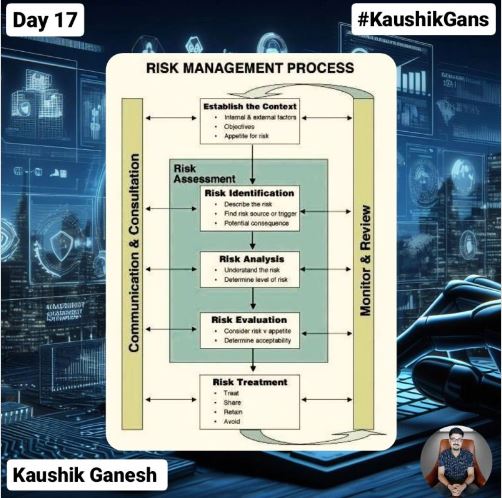
Risk management is the process of identifying, analyzing, prioritizing, treating, and monitoring risks that may affect a project, an organization, or any other entity. Here are the common steps of risk management:
1.Establish the context: This step involves defining the scope, objectives, and criteria for risk management, as well as identifying the internal and external factors that may influence the risk assessment and treatment.
2. Identify the risk: This step involves identifying and documenting the potential sources, causes, and consequences of risk, using various methods such as brainstorming, interviews, checklists, surveys, etc.
3. Analyze the risk: This step involves estimating the likelihood and impact of each risk, using qualitative or quantitative methods, such as risk matrices, probability distributions, scoring systems, etc.
4. Prioritize the risk: This step involves ranking the risks according to their severity and urgency, using criteria such as risk exposure, risk appetite, risk tolerance, etc.
5. Treat the risk: This step involves selecting and implementing the appropriate risk response strategies, such as avoiding, reducing, transferring, or accepting the risk, depending on the cost-benefit analysis and the risk preferences of the stakeholders.
6. Monitor the risk: This step involves tracking and reviewing the performance and effectiveness of the risk management process and the risk response actions, using indicators such as risk registers, risk reports, audits, feedback, etc.
7. Review and evaluate the risk: This step involves updating and improving the risk management process and the risk response actions, based on the lessons learned, best practices, and changing circumstances.
I hope you find this post useful and informative. Please feel free to share your thoughts and feedback in the comments. Stay tuned for more posts on cybersecurity, risk and compliance in the coming days.


