


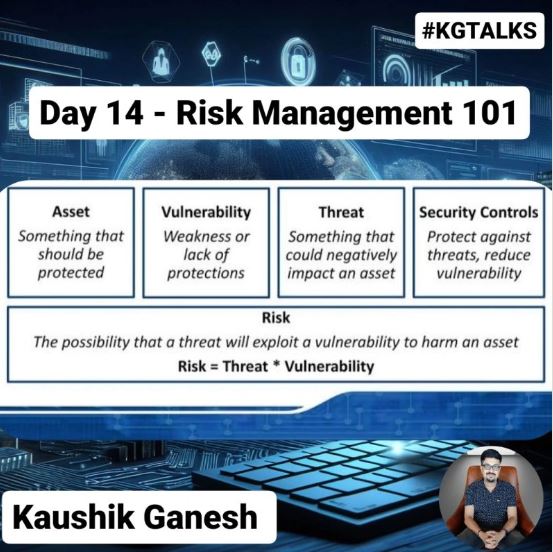
Risk Management 101!
Risk management is the process of identifying, analyzing, evaluating, and addressing the potential threats and vulnerabilities that affect an organization’s information systems and data. It aims to reduce the likelihood and impact of negative outcomes caused by cyberattacks or other events. Some common related terms that are used to describe various aspects of managing risks are as follows:
Asset – It is anything that has value to an organization, such as people, property, data, or information. Assets are the resources that an organization owns or controls, and they are the targets of cyberattacks or other threats.
Threat – A malicious act or event that seeks to harm or compromise a system or network. Threats can come from external sources, such as hackers, malware, or phishing, or internal sources, such as disgruntled employees or human errors. Threats can exploit vulnerabilities to create risks.
Vulnerability – A weakness or flaw in a system or network that can be exploited by a threat. Vulnerabilities can be caused by design errors, configuration errors, software bugs, or lack of security awareness. Vulnerabilities can increase the likelihood and impact of a cyber attack.
Risk – The potential for loss or damage of assets or data caused by a cyber threat. Risk can be calculated as the product of threat, vulnerability, and impact. Risk can never be completely eliminated, but it can be managed and reduced by implementing security controls.
Security controls – They are any type of safeguard or countermeasure that are used to protect assets from unauthorized access, use, disclosure, modification, or destruction. Security controls can be classified into three types: physical, technical, and administrative.
Understanding risk management and its related terms is essential for developing and implementing effective cybersecurity strategies. By identifying and assessing the threats and vulnerabilities that affect an organization’s information systems and data, one can prioritize and mitigate the risks that may result from them.
I hope you find this post useful and informative. Please feel free to share your thoughts and feedback in the comments. Stay tuned for more posts on cybersecurity, risk and compliance in the coming days.


